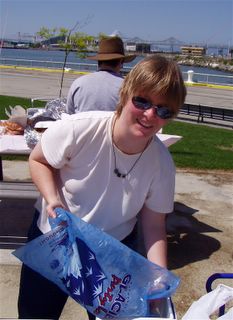
When I travel in a new city, I often like to set some sort of shopping task for myself. It’s usually not important that I find the thing; looking for it just gives me some kind of framework for wandering the town.
In Beijing and Shanghai, though, there really was something I wanted: Years ago, a friend gave me two cassettes by a Chinese singer named Cui Jian. He was China’s first bona-fide rock star. Just as the Beatles proved that rock ’n’ roll wasn’t exclusively American, Cui Jian proved that it’s not even necessarily Western. His music is a really interesting mix of traditional rock (he apparently loves Bruce Springsteen and the Rolling Stones) and traditional Chinese instrumentation.
I enjoy the tapes, but I’m trying to upgrade all my cassettes to CDs. This turned out to be harder than I expected, and I’m not sure why. Maybe his original albums, from the late 80s, are out of print. This seems unlikely, though, given how popular he was back in the day. Possibly, his older music is too politically incorrect. He did get in trouble with the authorities around the time of the Tiananmen student protests. His music isn’t overtly political, but his lyrics (I’m told—I can’t understand much) are metaphorically about rebellion and make leaders nervous, without their being able to put their finger on a specifically offending verse.
Whatever the reason, I stopped in practically every CD shop I could find in Beijing and Shanghai, slightly annoying my traveling companions. I couldn’t find either album anywhere, though. I finally settled on a newer album that had Cui Jian’s two most famous 80s songs tacked on. It was terrible. I hated the new stuff—it sounded like an ill-advised foray into rap backed with Chinese opera instruments. And one of the older tracks was corrupted, and wouldn’t play at all.
Just today, though, I found a message-board posting that mentioned a Chinese Web site called YesAsia.com. I went to it, and as luck would have it, they have one of the two albums I was looking for.
I don’t regret the time I spent looking for the CD in China, but it’s good to know that sometimes these things can be purchased without even leaving my desk.
Thanks for being patient, John and Pipi!
Tuesday, September 19, 2006


Friday, September 15, 2006
The Analog Tourist
Actually, I take that back. There is one time I was happy to have a film camera. It was in Cuba a few years ago. (Yes, it was a legal trip. Please stop tapping my phone.)
The hotel we stayed in was ridiculously nice—far more luxurious than what Pipi and I usually stay in. I had brought a flashlight, and my own soap and shampoo, thinking this poor benighted country couldn’t possibly provide toiletries and 24-hour-a-day electricity. I also packed a tiny portable radio, because baseball playoffs were on, and I wondered if I might be able to catch a signal out of Miami to see how the Red Sox were doing. The hotel turned out to have ESPN and high-speed Internet. That was humbling.
One other thing surprised us about the hotel. We’d all read that electrical sockets in Cuba were just like ours. As it turned out, though, this particular hotel was a Dutch/Cuban joint venture that tended to attract a mostly European clientele, and they had European style sockets. As a result, everyone with digital cameras spent a lot of time at the front desk trying to borrow the few available adaptors the staff kept on hand. On day three, one guy on the trip cannibalized my flashlight batteries to run his camera on. It was a good time to be analog.
Thursday, September 14, 2006
For the Sake of Sake
I bought a digital camera for two reasons: I was sick of paying to develop bad pictures, and I wanted that little preview screen so that I could tell right away if a photo was bad.
I got my wish with the first part—it is indeed easy to avoid sending bad photos to the printer. The second part, though, didn’t work out quite as well as I planned. Lots of photos that looked fine on the tiny screen turned out to be blurry when enlarged to 4x6, or someone had their eyes closed, or was making a face. But I often wouldn’t notice until it was too late to take another, so I’d be stuck with it.
There is one great thing, though, about a digital camera that I didn’t anticipate. Now that I have one, I have to take many fewer notes when I travel.
If I don’t feel like writing down a whole history of a temple I’m visiting, I don’t have to. I just take a picture of the plaque out front. If I can’t read the characters on a street sign on a boulevard in Beijing, I don’t have to transcribe it. I can just take a picture and look up how to pronounce it later.
When I was in Japan, visiting John’s partner’s family, we were served a sake I really liked. That’s a rare thing—most sakes either taste like gasoline to me, or else they’re cloyingly sweet. I knew there had to be a happy medium somewhere, and in Odawara, I found it. I liked it so much I wanted it for myself.
I could have written down the name, and gone to a wine shop and bought a bottle, but then I would have had to lug it across all of Asia and part of Europe. So instead I took a picture of the bottle, so that I’d have a record of the name with no chance of transcription error on my part.
I had a scary moment when I uploaded the photos to my computer the next day, in another town: The shot turned out so blurry that only two big characters on the label were legible.
Just this week, though, I emailed a copy of the photo to a sake store in San Francisco, True Sake. A very helpful person emailed back that he recognized the label, blur and all, and told me that they can get it for me. It turns out to be a brand called Masumi Cho-Karakuchi Ki-ippon Junmai Ginjo. Please don’t laugh at me if you recognize this as a lowbrow brand (though I doubt Daisuke’s family would have served it if it were.) I don’t know much about sake. I just know what I like.
And I know that I’m never going anywhere without my digital camera again.
Wednesday, September 13, 2006
Dates Firmed Up
I have my reservations now. I’m leaving out of SFO on the morning of Sep. 26, and returning the evening of Sep. 29. Sep 26, incidentally, turns out to be the day of my father’s last flight—he’s a pilot and will hit the FAA mandatory retirement age the next day.
The one thing I know we have planned is a retirement party at a restaurant called Wheatleigh. It’s a swanky place near Tanglewood in Lennox, MA that my Mom recently had a big birthday at. It had just about the best beef I’d ever eaten. I’ve only had beef once since then, in fact, and that was at a wedding, so you can imagine it wasn’t the same. I need to dispel the ghost of that wedding steak with more of that good Berkshire beef pronto.
The one thing I know we have planned is a retirement party at a restaurant called Wheatleigh. It’s a swanky place near Tanglewood in Lennox, MA that my Mom recently had a big birthday at. It had just about the best beef I’d ever eaten. I’ve only had beef once since then, in fact, and that was at a wedding, so you can imagine it wasn’t the same. I need to dispel the ghost of that wedding steak with more of that good Berkshire beef pronto.
Tuesday, September 12, 2006
Anything Funny Happen Today?
Pipi used to have an acquaintance with a preschool-aged daughter. The mother told us once that she figured out pretty quickly that the question, “How was school today?” seldom got much of a response. Somehow she realized that a much better question to ask is, “Did anything funny happen today?”
Sometimes Pipi and I greet each other with this question when she gets home from work. And if she asks today, I’ll be able to say “yes.”
This morning I was on one of my Oakland urban hikes. I went down East Twelfth Street as far as First Avenue. It was a good walk—I discovered that an Asian supermarket that burned down about a year ago has reopened in a temporary location, so that was good to know.
That’s not the funny part, though. The funny part is that on the way there, some cops pulled up next to me and asked me for directions.
That’s a funny enough scenario—police officers lost in their own jurisdiction. But as anyone who knows me realizes, the really funny part is that they picked the absolute worst person on Earth to ask directions of. Seriously, for an explorer, I have no sense of direction. My father has written a book on navigation, but I can’t find my way out of a paper bag with a compass.
The story does end happily, though. They were looking for the Scottish Rite Temple, and I actually did have a pretty good idea where it was. It helped that they were already quite close, and it’s a big building.
Almost the funniest part is imagining why they needed to find the Scottish Rite Temple in the first place. Did a ritual go bad? Was someone playing caber in the house? Was there a haggis incident? I’m definitely picking up an Oakland Tribune tomorrow to find out.
And the next time I call the police, I’m definitely keeping Mapquest open while I’m talking to the dispatcher.
Monday, September 11, 2006
One Cingular Sensation
My cell phone was useless when I was in Japan, and I assumed it would be useless across much of Asia. I almost didn’t bring it on my trip at all, but I had this idea that it might work in Russia, so I took it along for emergencies.
Imagine my delight when I flipped it on in Shanghai and found it worked perfectly. It even knew the local time. When I was waiting at the airport to meet Pipi’s flight, I was able to leave her a message assuring her I’d be there.
I experimented with phone cards for calling home, but they’re expensive and the concept is hard to pantomime in a store. Eventually Pipi got Skype on her computer, and this seemed to solve the problem completely. She loaded up $10 worth of credit on her account, and in several weeks of calling my cell phone regularly, she didn’t even burn through that. Problem solved, or so it seemed.
Imagine my surprise when I opened my first Cingular bill when I got home and discovered an astronomical charge. I’m not going to say how much it was, but let me put it this way: I’ve seen used cars sell for less. And they sort of ran, even.
The moral is: Skype is a great thing. But for the love of Pete, don’t use it to call a cell phone internationally unless you understand your plan’s international roaming charges perfectly--that includes inbound calls as well as calls you make.
Friday, September 08, 2006
Urban Hiking
I forgot to mention a close-to-home travel project I’m working on. Recently I read an article about people who walk every street in their city. It was mostly about people walking San Francisco, which at 49 square miles, is achievable within an average lifetime. (Actually, it only takes a few months, if you’re really dedicated.)
So I’m doing Oakland now. Realistically, I probably won’t ever walk all the streets—I think I read that there are about 800 miles of paved road within the city. Some of them are war zones. Worse, some of them are really hilly. Also, I don’t’ walk very fast and I only have a few hours a week to devote to the project—I usually only walk two days a week.
Nevertheless, I am making some real progress. I don’t know how many miles I’ve covered so far. Thirty would be a rough estimate. Maybe more. For those of you who know Oakland, I’ve covered a lot of Eastlake: most of the streets between MacArthur and International Boulevards on the (roughly) north and south, and First through Fourteenth Avenues on the east and west.
It’s been interesting for me to explore a place I thought I knew pretty well. I’ve discovered that within walking distance of my apartment, there are several antiques stores I didn’t know about, a bubble-tea place I can get to in about 15 minutes, and lots of architecture I’d never noticed. I’ve realized that “walking distance” from my place includes a much wider area than I ever knew. It’s fun, it’s educational—it’s travel, in a way.
I don’t have a scanner, but I’ll try to find a way to track my progress online for you. Stay tuned.
Thursday, September 07, 2006
Ten Must-See Hilltowns for Fall
People often ask me where I’m going next, hoping I’ll say someplace exotic. But in fact, for the last few weeks, I haven’t had anything up my sleeve at all. But now I do have a trip planned, or at least penciled in: I’m going back to Northampton at the end of the month for my father’s birthday/retirement party.
I don’t know the exact dates yet; my homework for tonight is to look at flights into Harford that week. I’ll keep you posted. (So to speak.)
I don’t know the exact dates yet; my homework for tonight is to look at flights into Harford that week. I’ll keep you posted. (So to speak.)
Wednesday, September 06, 2006
Writer’s Rite of Passage
I’ve heard of this happening to travel writers, but this is the first time it’s happened to me: After sending off a 2000-word article on Mongolia, suitable for the cover of the San Francisco Chronicle (I’m determined to make that guy publish me), I pick up my Sunday paper. And what’s the main teaser on the front page? An article on Mongolia. Written by someone else.
This article wasn’t the cover article, it was much shorter, and covered a different angle. Mine was an Ulan Batar overview, whereas his was about the trans-Mongolian train line, with a little bit about U.B. attractions. Still, I doubt the Chronicle travel editor is going to run more than one article a year about Mongolia in any case. So I’m disappointed.
I’m trying to look on the bright side, though: At least I know now that Mongolia isn’t a completely off-the-wall topic. Maybe someone else will publish it. And I now have a good woe-is-me story for my next writers’ networking event.
It’s a milestone of sorts.
Tuesday, September 05, 2006
Rejection at the Speed of Light
The Cowboy Junkies have a wonderful song (“Sun Comes up, It’s Tuesday Morning”) about waking up in the morning and hearing the telephone ring. The singer doesn’t answer it, though, because, as she says, “Everybody knows that good news always sleeps till noon.”
And that may be true. All I know is that rejection sure seems to be up and at ‘em early these days.
It used to be that newspaper editors liked submissions via snail mail. It would take days for my article to get to their office, days or weeks for the editor to actually open the envelope, and the rejection, if one ever came, could easily come months later. (I once got a manuscript sent back to me nine months after I’d sent it to a certain San Francisco-based publication. Hint: not the Examiner.)
Now more and more editors are accepting e-mail submissions, which turns out to be a double-edged sword. The good thing about that is that I save tons of money on stamps, envelopes, and ink cartridges.
The bad thing is that the rejection is almost instantaneous. Overnight, in some cases. For example, I spammed a Mongolia overview article to 17 papers two weeks ago. The Kansas City Star gently but firmly rejected it the next morning. The Chicago tribune dinged it within a week. One submission bounced back (did the Atlanta paper get rid of their travel section?), and one of my emails drew an immediate auto response saying the editor was out on leave and that all her email was being deleted in her absence. It’s….what’s the opposite of instant gratification? When there’s no delay between an action and getting slapped upside the head for it? Do we have a word for this in our language?
We will soon.
Friday, July 28, 2006
Taking the “Dull” out of Dulles
Yesterday morning I was waiting at SFO for a flight to Hartford, CT, when I had a strange feeling I was going to run into my friend Jeremy. It was fleeting, and probably more wishful thinking than anything else, since I hadn’t seen him in a few months. I was probably only thinking of him since I was heading to Massachusetts, which happens to be where both of us grew up. “That’s silly,” I told myself, “Why would he be headed to Hartford when his family lives near Boston? And besides, he always takes US Airways red-eyes. He wouldn’t be in the United gate area, especially at this time of day.”
I quickly got distracted by something shiny and forgot about it. But later, I was roaming the hallways of Dulles, wondering how to kill a three-and-a-half-hour layover and fuming that the women’s restroom near my gate was out of order. (How does a whole room break? This doesn’t make sense.) I was also wondering what the chances are of running into my friend Wendy, who lives in Richmond (and who I happened to know was traveling that day), or maybe my grandparents, who live just outside of Washington, D.C.
I never did see any of them, but as I was stomping around angrily looking for a working bathroom, I was snapped out of my funk by someone calling my name. Oddly enough, it turned out to be Jeremy. He was also just passing through, and having anger issues of his own, having to do with a grossly delayed flight.
So we had a good old time amusing ourselves at the airport, gossiping about old co-workers and cursing United, for, I guess, not being able to control the weather better and not personally checking the plumbing at every airport they serve. It’s a small world.
Well, at least mine is.
Friday, July 07, 2006
Home Again
I’ve traveled 18,890 miles, covering all 360 degrees of longitude (and about 30 degrees of latitude). I’ve been through four countries, three of them new to me. I’ve traveled by plane, train, car, boat, bus, subway, rickshaw, bike, funicular, and cable car. I’ve worn out one shirt, a pair of pants, a watchband, a pair of sunglasses, and two socks (sadly not a matched pair). I lost four pounds. I gained 13,571 frequent-flyer miles. I slept in five different people’s homes. I slept in a nomad tent. I spent seven nights on a train. I learned how to say, “I’m sorry” in four different languages. I went 10 days without seeing a fully dark night sky. I went 36 hours without my luggage.
And now I’m home.
I felt ready to come home at the end of the trip, but that didn’t prevent me from some pretty intense culture shock. I woke up every day for a week not knowing where I was—that’s the longest that effect has ever lasted for me. It’s so good to be home, though. I’ve been drinking water right out of the tap whether I’m thirsty or not—just because I can. After weeks of train compartments and budget hotel rooms, my apartment seems huge, even though it isn’t really. I can’t believe that I can take a cold drink out of the refrigerator any time I want. I can put ice in my drink. I can eat anything I want without peeling it or boiling it. I can get a good cup of coffee anywhere. I know where everything is. I can tell what the weather is going to do.
The best part is that it’s just so good to see everyone. My cats have been like living earmuffs at night, sleeping one on either side of my head as if they’re afraid to let me out of their sight. Come to think of it, Pipi’s been acting similarly, which is sweet. We’ve been having a little bit of a honeymoon, which is nice and just might make up for six weeks of loneliness. (What’s worse than being lonely but not alone? Not much.) I’m finally starting to get caught up on emails and phone calls, although I know a lot of you out there are still wondering if I’m lost in Mongolia or something. I’ll be back in touch, I promise.
Because I’m not going anywhere any time soon.
Wednesday, July 05, 2006
Still More Photo Galleries
I’ve finally gotten to upload the last of the photos. Here are some images from Moscow and St. Petersburg, as well as links to the older photo galleries: Irkutsk, Lake Baikal, Train photos, Mongolia, Beijing, Shanghai, and three Japan galleries: Enoshima, Kamakura day 2, and Kamakura day 1.
Friday, June 30, 2006
A Setback
Almost six weeks into the trip, on the eve of John’s heading by himself to France for some R&R, we’ve had our first attitude-changing bummer of a travel experience: John got his camera stolen on the St. Petersburg metro. It was plucked right out of his knapsack while he was busy concentrating on protecting his wallet in a suddenly crowded car. He had been backing up photos on my computer, so he didn’t lose a lot of work, but he did lose a lot of camera. This was no point-and-shoot.
So if you’re in a St. Petersburg street market any time soon, and you see a nice Cannon camera for sale with a big lens (and photos already on the memory card), and the price seems too good to be true….it is.
So if you’re in a St. Petersburg street market any time soon, and you see a nice Cannon camera for sale with a big lens (and photos already on the memory card), and the price seems too good to be true….it is.
This is More Like It

Everyone likes St. Petersburg a lot more than Moscow. The people seem friendlier, the subway is less confusing, the hotel is nicer, and, most of all, it’s the first truly beautiful city I’ve seen on my trip. Irkutsk had quirky charm, and Moscow had quite a few beautiful buildings, but in St. Petersburg, virtually every downtown building is a handsome, several-hundred-year-old stone structure. My Mom and I have been walking the soles off our shoes trying to see it all. (John regards himself as on vacation for this leg, although he has been working on a market photo project. Mostly, though, I think he knows he can’t keep up with my Mom when she has a few cups of Nescafe and goes into full sightseeing mode. And frankly, neither can I. I lost four pounds on the trip, and I’m pretty sure I last saw them in St. Petersburg.)
Writing any articles about the city is going to be difficult because it’s going to be hard for me to find the new angle—I’ve never been here before, so I’m still hung up on seeing the obvious sights. I don’t have any secret St. Petersburg-type article ideas, because I’ve been enjoying all the well-known tourist spots so much. The Hermitage was great. (I’ve never seen a museum that leaves the windows open on a hot day, though.) Saints Peter and Paul Cathedral was beautiful, and full of crowds welcoming the Romanovs home. Peterhof was great, once we got past the idea that we needed to tour the main hall, which is shielded from visitors by a baffling and frustrating array of Russian-only entry times and hidden ticket fees. The Nevsky Prospect shopping area was interesting (Shopping? In Russia? Believe it.), full of coffee houses, ice cream shops, and art deco architecture. The churches are beautiful. It’s all beautiful. It’s just not much of a secret. St. Petersburg is one of those dream cities for a visitor, where a guidebook really can lead you to the good stuff. It’s just a little bit of a nightmare for a travel writer when a city wears its beauty on its sleeve like that.
See St. Petersburg!
Saturday, June 17, 2006
In Moscow
Nobody got off on the right foot in Moscow. Not John and I, who spent our first hour in the city stuck in rush hour traffic with a driver who had no idea where our hotel was. And definitely not my mother, who got bumped off her Aeroflot flight in New York and got here a day late.
And don't even get me started with the metro, which is truly the most beautiful system I've ever seen, with art in almost every downtown station, but which is also the most confusing system imaginable.
Yesterday, though, was a great day and I've forgiven the city for the rough start. My Mom and I went to a flea market and spent the morning shopping for trinkets. It was bright and sunny and even the Russians seemed to be in a better mood.
After lunch, the three of us went on an organized tour of the metro system. It was explained to me that Stalin knew he coudn't afford to give every Russian family a car, so he decided to give the people the next best thing: A really beautiful subway system. And it is. There's art everywhere. Some stations are full of absurd propoganda poster-style sculptures showing hale and hearty Russian youth defending the Soviet motherland with all their fuzzy-cheeked might. Some have chandeliers and ornate paintings, and look a little like Versailles. One has stained glass everywhere. My favorite one is kind of art deco, with stainless-steel arches and mosaics telling the (dubious) history of Russian aviation.
After dinner, my mom and I went to Red Square with the idea of watching the lights that illuminate St. Basil's cathedral come on. But because it never really gets completely dark this far north in June, we had to settle for watching the sun set until 10:30, when we got tired and had to go home.
Tonight we all take a night train to St. Petersburg, where we'll be for the longest day of the year. I'm actually looking forward to this city more than I was Moscow because it's supposed to be so beautiful. (Smaller, and less overwhelming, too.) It's also the last stop on my trip, which is both sad and exciting.
Moscow photos here!
Friday, June 16, 2006
Photo galleries are back!
Train Play List
Somebody wanted to know what was on my train play list. Here it is. I know it’s not every train song, not even every great train song. But it does include every great train song that I have- on my ipod.
Here are my train photos!
- Casey Jones, by the Grateful Dead.
- Mystery Train, by Elvis Presley.
- One After 909, by the Beatles.
- Driver 8, by R.E.M. I’m not actually positive that this is a train song--it’s so hard to tell with R.E.M. But since most train songs are really about something else, I think it works in any case.
- Crazy Train, by the Waifs.
- Draw Your Brakes, by an artist named Scotty, off the Harder They Come soundtrack.
- Folsom Prison Blues, by Johnny Cash.
- Midnight Train to Georgia, by the Indigo Girls. (I know, I know, but I don’t actually own the Gladys Knight version.)
- Peace Train, by 10,000 Maniacs. Here’s an example where I do own the original, but I think the record will show that Natalie Merchant was on the right side of history, so I went with her version.
- Gospel Train, by the Jones Brothers (off a Sun Records collection).
- She Caught the Train, by UB40.
- Tied to the Tracks, by Treat Her Right.
Here are my train photos!
Thursday, June 15, 2006
Day in the Life….
This morning, John said, “Well, just one more night on the train.” “Yeah,” I found myself saying, “I hope I have enough time for everything.”
I wasn’t entirely joking. Before I left, a lot of people asked me how in the world I planned to survive a weeklong train trip. The idea that I might actually enjoy it rarely entered into the conversation. And it’s true that if you’re the kind of person who likes to do things, this trip may not be for you. If, however, you are the kind of person who believes that doing nothing is something, then you might enjoy yourself as much as I am.
Even I was a little intimidated by a three-day stretch of completely unstructured time, so I set a few tasks for myself. I’ve always found that on long plane or train rides, having an assignment keeps me focused not on how much time I have to fill up, but on how little time is left. Plus, minor things take a long time on a train, and that helps pass the time, too.
Yesterday morning, for example, I woke up around 8am. If that sounds late, well, it is for me, but I’m a little jet-lagged from the constant one-hour time changes, and it’s hard for me to fall asleep when it’s still broad daylight--which it is until about 11pm here. Also, the train operates on Moscow time, so by that reckoning, I was up at 6am. That’s my story and I’m sticking to it.
Washing up, making coffee, and cleaning the caffeine paraphernalia take a long time in a place where you can’t brush your teeth with the tap water and anything washed in the bathroom sink has to be sterilized with boiling water from the samovar to be safe.
After breakfast, it’s reading time. I start by reading a guidebook that obsessively details every cemetery, airfield, factory, czar assassination site, and church you will pass each day, as well as the exact kilometer marker you’ll find these things near. When I think of the work this author put into his train trip, I feel like I’m on a Mexican booze cruise. Next I work on my magazines. I’ve brought a stack with me, one stratum of the tower of back issues I have at home. I don’t get very far before I decide that my time would be better spent reading what my two guidebooks have to say about Moscow. I have somehow neglected to read a word about the city, and I’ll be there in 48 hours, so time is running out.
I guess I should point out here that if you’re not a reader, this maybe isn’t such a great trip either. But I have seen all-day card games in the dining car, so there definitely are non-literary options.
It’s not until late morning that I get a start on my first project for the day: snapping a picture of the train going around a curve in the track. This too is harder than it sounds. Few train windows open, and the ones that do are locked and unlocked at arbitrary times according to the whims of the attendants. Then you have to wait for the perfect stretch of arcing rail, ideally not one with a belching factory in the background and definitely not one with a freight train in the way.
I’m making pretty good time, and I think I may get a jump on my afternoon projects, but the train pulls into Krasnoyarsk and that means a flurry of activity. I need to take a picture of the station water tower (for some reason, these are made with beautiful brickwork) buy piroshkies for lunch from babushkas on the platform, and start my train car census project. It’s too much for one short stop, so I decide to concentrate on finding lunch. There are no babushkas about, so I curse my luck and mourn the 20 minutes of my life that I can never have back.
John and I go to the dining car and chat with a new friend, a woman from Philadelphia named Yael. We all left from Beijing on the same day and have been running into each other all over central Asia ever since. We probably only talk an hour, but when you think about it, it can take a lifetime to really get to know someone, and seen in that light, an hour-long conversation isn’t just passing the time; it’s really more of a frantic race against the clock.
Towards the end of the meal, we are joined by two other travelers we first met in Irkutsk, Spanish students named Paulo and Josep. They inform us that they’ve just woken up. I don’t have the heart to tell them what I’m thinking: With this late of a start, they must be hopelessly behind schedule.
After lunch, I work on my second project for the day: a thorough census of the cars on the train. This involves not just counting the cars, but also recording how many cars are devoted to each class of service. Like everything, this too has hidden pitfalls. I plan to walk through each car noting the configuration, but eastbound, I encounter an inexplicably locked door, and westbound, I come to a third-class car, full of impoverished Russians lounging on three tiers of bunks with no doors between the carriages. I feel disrespectful parading through with my notebook, and so finishing this project will have to wait until I come up with a better survey method. I decide to peek into each car’s windows from the outside at the next stop. Much better.
I make a train play list on my ipod.
I listen to my play list.
I get a mug full of boiling water from the samovar at the end of the car.
I watch it cool to drinking temperature.
I watch Siberia go by, changing slowly from impassibly thick birch forest to swampy flat land with lots of sky and isolated clusters of trees.
Later in the afternoon, against my better judgment, I start a new task: Determining what the story is with the TV above our compartment door. When we first got on the train, a History Channel documentary about the building of the trans-Siberian railroad was playing. Then the station went blue and I’ve been too busy for TV since then. This afternoon, though, I drive John to distraction constantly jumping up and cycling through the channels. (He has no appreciation for the fact that this is something I’m doing purely for the sake of journalistic thoroughness, and that it is in fact, a fairly humiliating exercise for me because there’s no remote and I’m barely tall enough to reach the channel buttons.) My verdict: Beyond the occasional snowy soccer game broadcast in Russian, and wavery Ukrainian soap operas, there’s nothing on.
In the evening the train stops again and I complete my census by discretely poking my head into each car. I feel a great pang of accomplishment knowing my day’s work is nearly done.
John and I have platform snacks for dinner, because who’s got time for the dining car twice a day? I finish reading a two-month-old Via magazine, and then, although it’s not dark yet, it’s time for bed.
I still haven’t finished my Moscow reading. I never got a good water tower picture. I haven’t even begun my next project, which is finding and figuring out how to use the mythical shower said to exist on this train. Luckily, I’ve got one more full day on the train.
And lucky for me, it stays light very late here.
Here are my train photos!
Sunday, June 11, 2006
Rue St. Denis, the Paris of Monmartre

It seems like every city likes to describe itself as the Paris of someplace, Havana is the Paris of the Caribbean. Buenos Aires is the Paris of South America. Shanghai is the Paris of Asia. Now I find myself in Irkutsk, the so-called Paris of Siberia. That may sound like exaggerating, or damning with faint praise, or both, but in fact, there’s something to that. Irkutsk is sort of like the city that Socialism forgot. It has a minimum of depressing Soviet-era cinderblock apartment towers. What it does have is a lot of European style stone buildings. It really does look a little like Paris, or at least a European city in general.
Irkutsk also has a lot of cute wooden cabins. These are a throwback to the city’s early days as the wild east of Russia, when it was a place exiled political prisoners got to live after they were done with their sentences of forced labor in the mines, Wood was the one thing Siberia had a lot of (well, that and mosquitoes, but they’re not a cost-effective building material), so most residences were made of wood. Some of the old ones are pretty dilapidated by now, but it does give the city a sort of pioneer feeling. One minute you think you’re in an administrative arrondissement of Paris, and the next you think you’re in Juneau, Alaska.
(My Lonely Planet guidebook, by the way, says that Alaska used to be known as “The American district of Irkutsk,” so it’s not a coincidence that they resemble each other.)
Truth be told, there isn’t a lot to seen in Irkutsk besides the architecture, but I’ve seen a few sights today. There is a nice church, dating from the 1700s, with those great Russian onion domes and everything. And there are museums devoted to two prominent political exile families, all rich St, Petersburg socialites who led a failed plot to overturn the czar and had to live in Siberia for (in some cases) the rest of their lives. This is such a pleasant looking city that it’s hard to imagine that being such a terrible fate, but the museum shows what it was like to go from living among social x-rays to rubbing elbows with country bumpkins, It was a little like The Beverly Hillbillies in reverse. Or maybe something like The Simple Life for Russian aristocracy,
In other news: It stopped raining. Thanks for asking!
This will be my last post for a bit, I think. Tomorrow John and I get on the train and go all the way to Moscow, which takes three nights and most of the next day. See you in a few days!
Irkutsk photos
But it’s a Wet Cold

I’m trying to resist the idea that it always rains in Russia, and only in Russia, but it’s hard. On the way from Ulan Batar, the train stopped for about 20 minutes on the Russian border. There, three hundred yards into the former Soviet Union, it began to rain. It has now rained for two days straight. It’s weather that invites brooding. It’s wet. It’s gloomy. It’s Siberia. I’m beginning to understand why Russians look so dour all the time,
Siberia itself is actually quite attractive. I’m staying in a private home in a village of 600 people on the shore of Lake Baikal. The lake, of course, is dramatic, and the mountains are beautiful. The village is cute, too, with lots of weathered wood houses, some of which are painted bright colors and decorated with fancy wooden carvings that look a little like lace. Adding to the interest factor is the fact that half of the population is Buryat. Buryats are the native inhabitants of Siberia. They are mostly assimilated now, and speak Russian and live in houses, but they’re closely related to Mongolian nomads. In fact, an American woman I met who had somehow gotten invited to a Buryat home said all the wooden pieces were numbered, just in case the family ever got the urge to disassemble the dwelling and put it back together somewhere else.
The village I’m in just got 24-hour electricity six years ago, and still doesn’t have telephone service of any kind (I am posting this from the city of Irkutsk, about 100 kilometers away). Also no running water. The house I’m staying in does have its own sauna, though, so it’s not all bad. They’ve rigged up an interesting washbasin bath/bake dry procedure for bathing that works surprisingly well.
Our host is named Galena, and she’s a very sweet, stout babushka who is determined to feed us into docility. So far we’ve been stuffed full of sausage, cheese, bread, and cake. And that’s just breakfast. Other meals have included meat dumplings on rice and hearty vegetable soup. It’s all really good, and I’m beginning to understand why Russians look so well fed all the time.
Today we took a hike in the rain along the shore of the lake. The mist made it very atmospheric. I’d packed a poncho so I was pretty comfortable. The lake was stunningly dramatic in the changing light, going from looking like a deep green ocean to looking like gray pavement in minutes.
It’s been nice to have a little down time here. I’ve emptied my brain of all my Japanese and Mongolian pleasantries, and I’ve been learning a little Russian. I can’t say much yet but I have been teaching myself Cyrillic lettering. Our guide has been quizzing me, pointing out street signs and candy wrappers and making me read them out loud to her. It’s a little like being a child again, barely able to communicate.
Siberia photos!
Tuesday, June 06, 2006
Nomads, Idiots, and Saints
John and I and two other North Americans from our train were met in Ulan Bator by a woman named Bagah who piled us into a van and drove us about an hour outside the city to a ger (nomad tent) camp. But first there was a short tour of U.B, just enough to give us a taste of this quirky city. Most of it is very Soviet looking, with ugly square apartment blocks and ponderously sprawling government buildings. There’s a huge Tiananmen/Red Square sort of central plaza, tailor made for revolutionary rallies. There are men falling-down drunk at 2 in the afternoon. But there are also pretty, brightly colored gingerbread buildings, some deco facades, and lots of eccentric statues—the one outside the main bank looks like it could have been designed by Gaudi, one of my favorite architects.
The ger camp consisted of about 30 canvas and felt tents pitched in the middle of an enormous valley surrounded on all sides by low, rolling, completely treeless green hills. They had electricity, and I’d been told that these gers stayed in one place all year round, so I was starting to feel like I was getting a little bit of a Disnyfied experience. But the next morning, our guide took the four of us campers on a mile long trek across the valley floor to drop in on a nomadic family that had set up their tent there about a week before. To my surprise, their ger looked exactly like mine, with the same framework, felt covering, metal stove, and even furniture. Except that theirs didn’t have electricity, it was really the same. Well, of course mine didn’t have a baby goat living in it, but otherwise, I think I got a little taste of rural Mongolian life.
The nomad family invited all of us in, and gave us cookies that tasted like pie crust served with a thick, custardy cream on top (yummy), and milky, salted tea (not so much). They didn’t speak a word of English, and the one word we all knew, bayar-lalaa (“Thank you”) only went so far. But our bilingual guide translated. The family wanted to know where we were from, whether or not we were married, and how old we were. They probably thought our questions were a little wide-eyed, too (“Um, why is there a baby goat living here?”), but they displayed the kindness of saints. It turned out we were the first group of foreigners they’d ever entertained at home, so it was a learning experience for everyone.
(We were hardly the first foreigners they’d seen though; it turns out that the answer to the baby goat question is that the family raises cashmere goats for their fur--the harvesting process is non-lethal--and several times a year they travel to Ulan Bator to sell it.)
Having tea with real-life nomads was exciting enough, but as we were leaving, we realized that a new family had just parked their yak next door and were preparing to put up their tent. We watched, and got to help a little bit, although we were probably more in the way than helpful. The tents go together ingeniously, and it only takes a group (even a group including North American city folk) about half an hour to erect a large ger, including several layers of felt, a roof, stove, smoke hole, and wooden door. Afterward, we hiked back to our camp realizing we’d participated in something none of us had expected to participate in: a Mongolian barn-raising.
Here's my Mongolia photo gallery.
All Aboard
Yesterday at 7:40am train #23 pulled out of the Beijing rail station bound for Ulan Bator, Mongolia. It seemed that the train was about half full of Chinese and Mongolian travelers and traders, and about half Wai guo ren of various degrees of shabbiness. One of the train attendants took a photo of me in front of the carriage, and when I saw it I noticed that I didn’t look as happy as someone who’s getting something she’s wanted for almost 15 years ought to look. I knew that I was excited; I think Beijing just really took it out of me. I had a great time seeing friends and revisiting my past, but I think John and I are both really ready for the next phase of the adventure.
The two of us have a private compartment to ourselves. It’s a little cozy, but it’s fine. It has two beds, which double as seats during the day. It could be cozier still; many compartments have two sets of bunk beds, but we at least have a high ceiling. There’s lots of luggage space, and a small table with a thermos we can fill any time with boiling water from a samovar at the end of the carriage.
Everyone on the train seemed to deal with the excitement and the anxiety of departure differently. The child down the hall, known to us only as “Screech,” shrieked like someone had run over his puppy for about 100 kilometers. The two young techno guys next door (John dubbed them Dot and Com) yammered non-stop about the L.A. geek world with such maniac energy we wanted to bludgeon one of them to death with his own blackberry. John slept 11 hours (plus 12 at night), and I, happy to be off my feet for a whole day, made a little nest of reading material and caught up on my scribbling.
The scenery went from sooty gray urban fringes to mountainous countryside remarkably fast. On the way out of town, parts of the Great Wall (at Badaling, a part I had never been to) were spectacularly visible not far from the train. Mountains went to rolling farmland, and crops changed from rice to hardier plants that can survive the progressively flatter and drier land we passed through in northern China.
At about 8:30pm, we arrived at the Mongolian border, but we might as well have been 200 miles away. Customs officials came on the train and had us show our passports two separate times, and fill out multiple customs and health questionnaires. (One form seemed to be dealing with both, as it asked in one section if we were suffering from any mental illness, and in another if we were carrying any human tissue. John and I had a good giggle fit wondering about the possible connection between the two questions.) Then the train had to be taken to a giant shed where each car was raised up on a jack, with the passengers still in it, and the wheels were changed. I had no idea train wheels (called bogies) even were removable, but they have to be changed at the border because Mongolia Russia both use tracks a slightly different width from the rest of the world.
I wish I could tell you more about the train jack, but in fact, I slept through a lot of it. It was getting late at this point, and it was almost midnight when it was done. And we were only half through. We chugged about 20 minutes into Mongolia on our brand new wheels and stopped again, this time for Mongolian customs. There were more forms, and more questions, and even a half-hearted search. The upside of being the kind of person who looks like an easy mark for scam artists is that customs inspectors also seem to think I’m harmless, but even I got a quick rummage through my bag. John had to show the Japanese yen he said he had on him but we both agreed the woman really just seemed to want to know what Japanese yen looked like. It was hard to get annoyed about being kept up late going through my dirty clothes because they were so nice about it. The baby-faced Mongolian man who did our final passport check thanked us profusely, and as he was leaving, entreated us to “sleep now,” putting his hands under his cheek in the international gesture for slumber, just in case we hadn’t understood. John and I have decided that Mongolians are a little quirky and very friendly and without even having gotten off the train, we like the place already.
Here are my train photos!
The Great, or at Least Pretty Good Wall
When I was a first-year Chinese student I used to have class every morning at 9 in a room containing an enormous, grainy photo of the Great Wall of China. Someone must have turned one of their semester abroad photos into wallpaper and blown it up to about 8x10 feet. I don’t know how they did it but the engineering feat required to make a snapshot that big paled in comparison to the amount of work it was going to take to get me to China. Students who completed first-year Chinese with good enough grades were invited to study in Beijing for the summer on a foreign-study program Dartmouth had set up with Beijing Normal University. I remember that I needed an A- for the spring quarter to make the cut, and for a while there it looked like storming the wall on horseback with several thousand Mongol archers was going to be my only hope of getting into the county. I used to sit in the back corner where I could get a good look at that wall photo and say to myself “If I can just get through this, I get to go see the wall for myself.” And somehow, it worked.
(Well, except I didn’t get to go to China until 1992, but that wasn’t my fault.)
For this reason I’m really glad my experience at the Great Wall on this trip wasn’t my first time there. Because it was a really strange experience.
John and I hired a guide (a driver, really, since foreign visitors aren’t allowed to drive here) to take us three hours outside Beijing to the Simatai section of the wall. That went well: Mr. Johnny was nice, knew a lot about the wall, spoke good English, and seemed to be toning down his creative Beijing driving techniques for his American audience. The setting was beautiful. Simatai is about twice as far from Beijing than the other two developed tourist areas of the wall, and so it gets less traffic and looks a little more unspoiled and touristy than the areas tourist hordes visit. The parking lot was nearly empty except for a few vendors and we congratulated ourselves on spending a few extra bucks to get away from the tourists. We took a gondola nearly to the base of the wall, which here is on top of a steep ridge. A funicular took us further still, and left us with about 15 minutes of walking up steep stairs to get to the towers themselves.
On the way up a friendly couple attached themselves to us. Well, to me, really. John can look really grouchy when he needs to but I seem to have a sweet, slow-moving vibe that people here pick up on. At first, the woman made small talk with me, expressing admiration that I’d come all the way from California, and buttering me up by praising my Chinese. (Proof that flattery will get you everywhere with me, I guess.) But then it got awkward. She told me in Chinese that she and her man had no jobs, and something about kids to put through school. I warned John in English that we were being hustled, but there wasn’t much that could be done. There we were, stuck on a narrow path with no one else around, facing a choice of trudging upward for the next 15 minutes being subjected to a mobile guilt trip or turning back. We continued, trying to ignore the woman and her silent husband, but she persisted in trying fan us and take my arm whenever I stumbled on the oddly tiny steps.
At the top, there were a few other people on the wall, but this lady was our new friend, and we couldn’t shake her, even by refusing to answer direct questions, and even when I once abruptly turned away from her and walked the opposite direction. The unspoken request for money seemed to be hanging over the whole wall like a fogbank, and I literally couldn’t face her.
Finally she pulled out a package of Great Wall postcards asked us directly if we would by some. This overt request finally gave me the chance to say a direct no. She persisted, and I saw John and the man exchange a glance that I couldn’t read—John later said he thought the guy felt sorry for us. It was then that the man spoke up for the first time. I didn’t understand what he said, but the two of them had a ferocious argument about it and finally left us alone. We took the opportunity to scuttle away and barely made the last gondola down the mountain.
On the gondola, it was quiet, and I could hear the cool breeze blowing through the tress. Birds swooped overhead. The motor hummed soothingly, and the view was spectacular. I could look back and see a stretch of the Great Wall that went on for miles, disappearing into the haze. It looked timeless and serene, and suddenly the wretched beggar family seemed very far away. I realized that being on the wall had been a big letdown, but I appreciated the calm moments heading up and down when I was able to take in the view from afar.
Which just goes to show that maybe it really is the journey that counts, not the destination.
Here's my Beijing photo gallery.
Tuesday, May 30, 2006
Hutongs First

Because I’ve been to Beijing before, I haven’t felt the need to go back to sights I've seen, like Tiananmen Square and the Forbidden City, although John has been getting up early and doing most of that kind of sightseeing. Instead I’ve been catching up with people I know here and trying to see things I either haven’t seen before, or things that may not be around the next time I’m in Beijing, whenever that may be.
Yesterday John and I explored the hutongs a neighborhood that falls into both categories. A hutong is an alley, and I’d never visited this particular warren of them in the Xicheng District northeast of Tiananmen Square. Most of Beijing’s old hutong neighborhoods have been bulldozed and replaced with high-rise apartment buildings. This is probably a good thing for the residents who don’t have to live medievally anymore, but somewhat of a shame from a historical standpoint. Beijing is going through a building spasm right now to get ready for the 2008 Olympics. The authorities seem to be mostly leaving this system of hutongs alone, but only time will tell if it survives the wave of modernization.
John and I turned down the first alley we came to, and spent 45 minutes at a teashop that was only a few steps in. We realized quickly that we’d have to pace ourselves better, but it was worth it. The proprietress saw us admiring a wall full of ceramic tea mugs and spent the next half hour reeling us in gently. She had us sip cup after tiny cup of tea, including oolong, black tea with a sweet, smoky flavor far more complicated than any tea I’d ever tried before, and a brew made by dunking a ball of what looked like dried herbs in boiling water. After a few minutes, the ball opened up into a whole flower—a chrysanthemum, I think. I realized quickly that the $2.50 mugs were a loss leader and that the tea was where the profit was, but it all tasted so good that I didn’t mind. Almost an hour went by with our host praising my meager Chinese to the stars and caffeinating me to the breaking point. I did end up buying some of the black tea, which surprised even me because I’m really a coffee person. But somehow the storeowner had won me over and made me into a tea drinker in one morning.
Fueled by six different kinds of cha, John and I set out to explore further into the neighborhood. It was an appealing maze of twisting alleyways, which is a huge contrast to most of Beijing, which is laid out in an L.A.-style grid of long, wide, straight boulevards. I thought the best part of the day would be walking around the lake in the middle of the district, but the lake turned out to be lined with backpacker-friendly bars where happy hour started at 10am, and pan-Asian noodle houses that reminded John of places that catered to trekkers in Katmandu. There were also aggressive rickshaw drivers anxious to take us on tours of the neighborhood. They all knew only one word of English: “HELLO!,” barked at sea-lion volume, and if it didn’t get their attention, they would yell it louder and grab your arm to make sure you knew they were there. John knew two good tricks to get rid of them, though. The first is to simply break down and take a tour, which buys you an hour with nobody demanding you take his. We chose the second method, which was to rent bicycles. Most of the drivers understood that if we were on bikes we weren’t likely to abandon them to get in their cart, and we could outrun the few aggressive ones who persisted.
Bikes are also a good way to explore the alleys, and it was a joy to ride through narrow passageways and suddenly come out into a small hidden square containing a market and a two-table restaurant with the chef cooking skewers of meat on a tiny grill outside.
We got lost a few times, but that was part of the fun. Finally trudging back the way we’d come that morning, we got an enthusiastic wave and a hello from the tea lady, who seemed genuinely happy to see us again. We had a moment of appreciation for her and her soft-sell approach, and I hope that Beijing’s Olympic modernization drive includes an effort to rediscover a little bit of this kind of old-fashioned marketing.
Here's my Beijing photo gallery.
Past Meets Present

Let’s be honest: Beijing is not a beautiful city.
In fact, it’s dusty, gritty, grimy, polluted, and several other kinds of dirty that I can’t think of the words for just now. In addition, it’s crowded and has the most chaotic traffic I’ve ever encountered. (No, I haven’t been to your hometown, so yes, maybe your drivers are worse, but believe me, this is bad.) The pedestrian is at the absolute bottom of the pecking order, getting to cross the street only when every car, bike, scooter, motorcycle, truck, bicycle rickshaw, taxi, horse-drawn carriage, and pushcart driver who wants to run the red light has done so, To stroll Beijing is to risk death half a dozen ways, ranging from emphysema to being run over by a melon vendor.
But, Beijing is also a city of amazing sights that everyone should see once, and for me, it’s a place full of personal history that I’m glad to return to. I’ve revisited sights I remember from 1992, and connected with two people I am very happy to have seen. One is my host, Tim Pettus, who is the father of a good friend I met while studying Chinese in college. The other is a long-lost friend named Matt, who was my T.A. in freshman year Mandarin class. We’ve been in sporadic touch over the years, but I hadn’t seen him since he graduated from college in the summer of 1990. I remember Matt at 22, wearing jeans and a yellow hoodie that may have been the only warm garment he owned. The man who got out of the taxi cab was wearing a dress shirt and blazer, and carrying a briefcase, simultaneously paying the driver and checking in on his kids by cell phone. But I recognized him instantly, and we had a great time catching up over dinner with his family. He lives here now, having created a life for himself in the suburbs of Beijing. It was strange but beautiful to see someone I remember as a big kid with a house and kids of his own. It reminded me that while it may seem like little changes from day to day, 15 years of days can add up and somehow make you a grown-up without your even realizing it.
Here's my Beijing photo gallery.
Sunday, May 28, 2006
Last Day

Pipi and I spent our penultimate evening in Pu Dong, the new area west of the Huang Pu River. This area was farmland until 1990, when plans for development were announced, and I don’t remember much of anything being there in 1992. Now, though, it’s a futuristic business center. Because it’s mostly office buildings, there isn’t a lot for a visitor to do, but it is interesting to walk around, and there are plenty of restaurants. It was already dark when we got there, and the buildings looked particularly surreal. The Pearl Orient tower, a combination TV tower and observation deck, looked like a rocket ship with its glowing purple spheres. Most buildings glowed brightly, even though everyone should already have gone home, but some were completely black, and I realized it was because they weren’t done yet. Everywhere you looked there were cranes, and because construction goes on 24 hours a day here, some of the empty black hulks had welders’ sparks pouring out of windows. It was a strange and eerie sight, but I guess that’s what it takes to put up a whole city in less than 15 years.
The next day Pipi and I spent walking the Old Town district, and the former French Concession. I remember finding the French district overrated in 1992. I had the worst cream puff of my life there (Crisco puff was more like it), and I realized there just wasn’t much French influence left there, for better or for worse. That’s still sort of the case, and I wouldn’t recommend anyone go out of his or her way to visit. Old Town, on the other hand, is very interesting. A lot of people there live somewhat like what we saw near the candy factory, and a lot of it has been renovated and preserved. There’s a section of the old city wall visible. It’s not very old, maybe mid 1800s, but in forward-looking Shanghai, that’s ancient.
In between the French Concession and Old Town is an area called Xin Tian Di, literally “new heaven and earth.” The area is essentially an upscale pedestrian shopping mall with an old Shanghai theme. The storefronts have been constructed (or restored, in many cases; this isn’t a complete sham) to mimic a style of building popular in the early 1900s. There are a lot of Western-style restaurants and cafes, and stores with American and European brands. The Chinese restaurants are pretty upscale, too; Jackie Chan owns a cafÈ in the mall. The restaurants and stores could have been plucked from an outdoor Southern Californian mall, but the architecture is authentically Asian. A small museum devoted to the architecture described Xin Tian Di as a place the Chinese find Western, Americans find foreign, the elderly consider nostalgic, and the young deem hip. In a sense, all of Shanghai is like this, and this mix of Eastern and Western consumer culture is probably something we all should get used to.
Shanghai photo gallery
Down the Rabbit Hole

Is there anyone else out there who likes White Rabbit candy as much as I do? They’re little Tootsie Roll-shaped candies, very chewy. They come wrapped in edible rice paper, and they’re very sweet. The basic flavor is like condensed milk, but you occasionally see mango and sometimes lychee flavor in the United States.
The wrappers on the American candies give a Shanghai address, so Pipi and I made a pilgrimage. The factory was a long walk from a metro stop. The street was easy to find but we didn’t think we’d ever get to the right number until finally I noticed that the high wall we were walking beside had strange little rabbit decorations on top. A few steps later, we realized we could smell the intoxicating scent of hot condensed milk and we knew we were in the right place.
We entered the gate and walked past a guardhouse, where there was a giant map of the complex, all in Chinese. We were allowed to look at that as long as we liked (not that it was much help), but as soon as we went a step further, the guard started yelling. I’m not sure what he said—something about capitalist running dog candy spies, maybe? At any rate, we sweetly explained that we were looking for White Rabbit. We meant the factory, not the candy, but he directed us to a doorway covered in plastic flaps near the main gate. It wasn’t the kind of doorway that said “Factory shop here.” It was more the kind of doorway that said “Here’s where the dangerous machinery is; keep out.” But in fact, it was a little factory store. The main counter inexplicably sold cigarettes, but in the back room, there were bags and bags of White Rabbit, in all kinds of flavors we’d never seen, including mint and yoghurt (both good) and red bean (not so much good).
Afterward, Pipi and I decided to walk around the perimeter of the factory. The front was on a busy street, but the back of it was flanked by a small, poor, crowded residential neighborhood. I saw some people watching TV, and Pipi swears she saw someone on a computer, but for the most part, it was a classic overcrowded Chinese city scene, with communal bathrooms, adults sitting around fanning themselves, and children toddling around wearing pants with a split down the back rather than diapers. It was pretty shockingly squalid, but I was almost relieved to see a glimpse of what I remember China being like after the Emerald City experience of downtown Shanghai.
What made the scene even more poignant was that our next stop was the Shanghai Center, a complex containing both a theater where acrobats perform (our reason for being there), and the Ritz Carlton hotel. Going from a neighborhood of filthy row houses to umpteen stories of opulence, built in a faux Chinese temple style, was a jarring juxtaposition. It made me wonder what elderly Shanghai residents, those old enough to remember the international concessions, think when they see white faces on the streets. Do they see visitors with an honest curiosity about their culture? Or do they see a second wave of Europeans flaunting their wealth and doing as they please?
Shanghai photo gallery
Friday, May 26, 2006
What We’ve Been up To

Pipi keeps asking me what I did when I was in Shanghai last, and the strange thing is, I can’t really remember. I remember walking along the Bund, Shanghai’s famous European-style main drag, and I remember multiple trips to a general-delivery post office to try to pick up an absentee ballot that never came (it’s harder than you might think to vote absentee in a Communist country). I barely even remember where I stayed, except that it was near a cigar factory, and that the bus that went there was always so crowded you couldn’t see out the windows—you just had to start pushing your way to the front as soon as you smelled tobacco. They’re probably still talking about the day I realized I’d never make the door in time and squeezed out a window instead.
Then again, maybe they aren’t. I can’t seem to remember any of my personal history in Shanghai, and the whole city seems to have a similar problem. There aren’t many signs of Shanghai’s history around. This is a city that is looking to the future. And in fact, the first sight we went to see was the Shanghai planning museum. This museum is essentially a big advertisement for a world expo that is being held in Shanghai in 2010, but it’s a really cool one. It’s full of interactive video and virtual reality exhibits showing how fast Shanghai is growing and how quickly it’s modernizing. It’s all spun very positively, but once you know what to look for, it’s hard to ignore the cranes and wrecking balls knocking down old apartment buildings so that new high-rises with plumbing and air conditioning can be built—not necessarily with the same tenants. (I’m not saying it’s good, I’m just saying it’s interesting.)
We also took a tour of Shanghai’s Jewish history, which sounds like a joke, but isn’t. Jewish real estate moguls built a lot of Shanghai’s famous hotels, like the Peace Hotel (seen in the movie Empire of the Sun). Later, the city sheltered tens of thousands of European Jews fleeing Europe in the 1930s. There’s not a lot of this history left, but you can see bits if you are shown where to look. We were taken to one alley in North Shanghai, for example, that was home to about 1500 Ashkenazi Jews. Today, everyone there is Chinese, but if you look closely, you can still see nail holes in each doorway where a mezuzah (a tiny box holding a Hebrew prayer scroll) once was. It’s very moving, and a little chilling, but still, this story is still a lot happier than that of most Jewish families of the time.
Don’t worry; we’ve done a lot of fun things, too. We took a cruise up the Huang Pu River to the place where it meets the Yangzi River. We shopped Nanjing Lu and discovered the fine art of haggling while shopping for artwork. (The dramatic man who sold Pipi the scroll swore we’d talked him down so far his boss would punish him, but we left before the beatings began.) We made a pilgrimage to the White Rabbit candy factory. We saw the Shanghai Museum, said to be the best museum in China, and I guess I agree even though the coin exhibit was closed for “inner re-arrangement.” I walked around People’s Park early in the morning and watched elderly people start their day by doing Tai Chi as well as badminton and ballroom dancing.
We’ve also eaten ourselves silly, of course. We’ve made discoveries ranging from Shanghai’s trademark Xiaolongbao, which are broth-filled pork dumplings that I think I could eat every day for the rest of my life, to McDonald’s taro pie. Almost every day I have a pork bun for breakfast, unless I have a greasy egg pancake. I missed out this morning, though, because I slept until the outrageous hour of 7:30, when Shanghai is beginning to think about lunch. So it was croissants for Pipi and me. Tough day. At lunch, Pipi and I decided to splurge and go to a famous old restaurant. The food was great—crab dumplings and the best bok choi ever—but the ambiance was so weird we left before dessert. The whole time we were eating the staff were yelling back and forth to each other and throwing plates around setting up for dinner. It made us long for the florescent-lit lunch counters we’d been thinking we needed a break from.
Next up: The French area of Shanghai, Old Town, and Pu Dong, an entire city that has sprung up across the river from Shanghai in the time between my visits.
Shanghai photo gallery
Wednesday, May 24, 2006
Fractured English

I had always been told that Japan is the world capital of fractured English slogans and t-shirts. Having been to China, I found that hard to believe, and now, having been to both, I am willing to take a stand: China makes the world’s weirdest t-shirts and billboards. Japan may have cornered the market on non-grammatical and charmingly malapropish English phrases (Pocari Sweat sports drink, for example), but China has the monopoly on the just plain weird. For example, I had only been in the country a matter of hours when I saw a middle-aged man at the airport meeting a flight wearing a t-shirt that said “Lesbians Taught Me.” (And believe me, I was dying to see the party he was waiting to meet.)
Later Pipi and I saw a teenaged boy near People’s Park (and within walking distance of the site of the first Chinese communist party meeting) wearing a shirt that said “Commies Aren’t Cool,” and I wonder if we were the only ones who saw the irony in that.
Shanghai photo gallery
Shanghai Surprise
I had a minor anxiety attack on the plane circling Shanghai when suddenly it hit me that I would, in a matter of moments, be back in China. As much as I enjoyed and appreciated my experience backpacking here in 1992, the country also exhausted and exasperated me, and I wondered what in the world I was thinking, not just returning to my personal Waterloo but also dragging along someone I love.
Almost from the second I landed, though, I realized I was in a completely different place. Sometimes, in fact, I wonder if I didn’t get on the wrong plane and end up in, I don’t know, Singapore, maybe. So little is familiar. I miss some of the charming old aspects, like sidewalk tailor stands, and old people shuffling around in blue jackets and caps. And I’m not crazy about all the new developments, like traffic jams and beggars. But for the most part China seems to have taken an enormous (perhaps even great) leap forward. When I was here last, China seemed to be in an awkward adolescent phase, trying really hard to be something it wasn’t ready to be. In 14 years, it’s grown up a lot, and it’s still tripping over its own feet a little, but it’s easy to see what it’s going to be like when it’s a fully grown modern city.
Actually, it’s really just about there. It has most of the trappings of a Western city: Shopping malls, a subway system, Starbucks, skyscrapers, even a Ferrari dealership. Many of the old, backward customs seem to have fallen by the wayside: Nobody spits on the street anymore, and I just realized recently that nobody stares, either. The gawking and the constant chorus of “hello, now we practice English” used to drive me bonkers, but I don’t get a second glance now. The novelty of blue eyes in Shanghai seems to have finally worn off.
It’s not just the skyline and mucus management techniques that have changed, though. The country just seems fundamentally more welcoming. I used to have a stock spiel I would give when someone asked me what was difficult about traveling in China. I would say how in a communist country (and one with no tipping, at that) there was no incentive for anyone to give good service. I would complain about how foreigners were seen as there to be milked for their perceived fortunes (the practice of charging visitors double the Chinese entrance price has fallen by the wayside, too). But now I feel terrible about every bad thing I said about China during its peevish development years.
I keep thinking of a time during my first visit when I was homesick and I passed a long-distance telephone office. I thought how nice it would be to call home. So I went in, and found four women behind a counter playing cards. There was nothing else in the room except for three telephone booths, all inexplicably barricaded off from the rest of the room by a wall of sandbags four feet high. It was hard to get the attention of any of the women, but finally I managed to get one to tear herself away from her card game long enough that I could tell her I wanted to make a phone call. “Phone call?” she snapped incredulously, “To make a phone call, you need to go to the bus station.” That seemed odd, but who knew more about long-distance phone calls than someone who worked at the phone office? So I got on another bus and went to the main station. When I got there and asked about making an international call, they looked at me the way someone might look at you if you went to your local AT&T office and asked when the next bus to New York was leaving. There was no hope of getting what I wanted there. I’d been had by someone who just didn’t want to help me.
Contrast that with the last 24 hours here, when Pipi and I seemed hell-bent on self-sabotage, but were saved from ourselves every time. First I overpaid for dinner by 10 kuai (about 25 cents) and a waitress chased me down and gave me the extra bill back. Then I left an umbrella at a café in a museum, and they found someone to make an announcement about it in English over the loudspeaker. The next morning, Pipi and I were waiting in the lobby of the Peace Hotel for a tour we’d signed up for to begin when a Chinese man sidled up to me and asked my name in broken English. At first I thought he wanted to know if I was part of the tour group, but then I noticed he had Pipi’s credit card in his hand—she’d left it in the ATM outside, and this man had taken it upon himself to ask the name of every wai guo ren in the lobby until he found a match. Getting out of a cab in the afternoon, I dropped my sunglasses in the street and didn’t even notice until I heard a traffic cop yelling “Hello, hello” over and over again. When I finally looked, he made the international finger-circle-around-the-eyes gesture for glasses and pointed to mine lying in the street. When he realized I was a slow-moving foreigner, too frightened to dart into the endless stream of rush-hour bikes and kamikaze cars, he waded into the traffic himself, then came all the way across the intersection to give my sunglasses back to me. It’s true that he had his traffic cop status to protect him—I think in just about any culture you’re in serious trouble if you run over the guy who’s supposed to be protecting people from getting run over—but still, I couldn’t believe someone would risk his life to help someone who isn’t doing a very good job of helping herself. Something has changed in China, and while maybe not all of it is good, it’s definitely making the country an easier place to visit.
Shanghai photo gallery
Sunday, May 21, 2006
Tokyo

After arriving in Tokyo, John, Daisuke, Kazuko, and I went directly to the main thing we’d come to see: the annual Sanja festival. Sanjen means “three gods,” The festival is a Shinto celebration of three deities that seem to be the particular favorites of the residents of the Asakusa neighborhood, This area is the closest Tokyo, mostly a sprawling modern city, has to a gothic quarter. It too is full of the post-WWII tile and glass boxes you find everywhere, but somehow the area survived both the war as well as the great earthquake of 1923 better than the rest of the city. It wasn’t all built from scratch in the 1950s, and there are lots of traditional wooden buildings and a few grand temples that still exist.
The festival itself was a surreal affair. It was easily the most flamboyant and fun religious festival I’ve ever attended. The Sanja Masuri neighborhood residents parade around dozens of gilded portable shrines. Each one weighs about a ton. It’s carried by men and women dressed in period costume, this period being the Edo period, from the early 1600s to the mid-1800s. For women that means a robe and leggings, and children wear cute smock-like garments and headbands. (“Everyone looks like a sushi chef today,” said Daisuke.) Grown men, however, wear a short robe and not much else—just a sumo wrestler-style undergarment. It takes some getting used to to see these guys, who on any other day wouldn’t dream of wearing shorts in public, not even wearing pants.
Groups of people dressed like this carry around the shrines, parading them through the neighborhood, They are quite boisterous when they do this, chanting in an exaggerated manner and keeping the shrine moving not just forward, but in a rolling up-and-down motion, too, like it’s a groom at a Jewish wedding. I later found out that back in the day, Asakusa used to be Tokyo’s theater district, so the showmanship makes sense.
After the parade, Daisuke and Kazuko headed home, and John and I grabbed our luggage out of the locker we’d stored it in and went to our hotel. Called the Homeikan, it’s about 100 years old, and started life as a boarding house for nearby Tokyo University. It’s a traditional Ryokan style building, with heavy wood, tatami floors, futon mattresses, and a bathroom down the hall.
It was here that I got my first real taste of the intensive Japanese slipper experience: When you check into the hotel, you leave your shoes on a shelf in the lobby and put on one of dozens of pairs of waiting slippers. You wear these to the door of your room, but not a step farther. When you enter the room, you leave your hallway slippers outside and pad around your room in your socks.
If you should want to use the bathroom, you put your hallway slippers back on and walk to the lav. But there you have to abandon your hallway slippers and step into a pair of bathroom slippers, waiting for you just inside the bathroom door. When you’re done, and this is crucial, you step out of the bathroom slippers and back into hallway slippers, At your room of course, you have to remember to take your slippers off before you enter. I’m glad the hotel is sparsely booked today, because I’m having a lot of trouble with this. I understand the system; it’s just that the slippers are so comfortable and natural that I’m having a hard time being mindful of my feet—I completely forget what I’m wearing the second they’re on. Which in a way is good because I don’t love the idea of wearing communal shoes, even with socks.
After dinner, I went by myself to the Shinjuku district. This is the neighborhood where the movie Lost in Translation took place, and it’s the neighborhood that looks most like I expected. When I got to Tokyo, I was surprised to see that most of it is low and drab. I expected it to be a 21st century maze of neon-lit skyscrapers, but in fact, that’s really only to be found in Shijuku, which is half Tokyo’s business center, and half an entertainment capital. It was a lot like I expected, with Times Square-like neon and thick crowds flowing in and out of video arcades and pachinko parlors. It was interesting, but the sight of so many people having so much fun when I was all alone and barely understood what was going on was a little alienating and put me in a little bit of a funk, so I went home pretty quickly and made a long trans-pacific phone call. Pipi couldn’t be showing up at a better time.
Hakone Area

Today John and Daisuke and I got up early and took the train to the town of Odawara, where Daisuke’s sister and mother live. This town is on the edge of the Fuji-Hakone-Izu National Park, which is, as you might guess, the home of Mt. Fuji. Ironically, though, it turns out that the closer you get to Fuji-San, the harder it is to see because mist and mountains block your view. Actually, John says one of the best views is from the beach in Hayama, where he lives.
The Sano family owns a fish-cake factory, and on the way into town we stopped by and said hello to the family, who were still at work. I got to try a fish cake. It was sort of like gefilte fish, and sort of like those processed chicken cutlets you get in school cafeterias. Not bad. What was bad was a treat Daisuke’s sister had just brought back from Okinawa. It was an individually packaged serving of tofu fermented with yeast, called Tohuyou. It looked like a little cube of pate smothered in ketchup, and it smelled like miso paste (so far so good), but it tasted like vegemite, which itself tastes like a salted barnyard, so not so good.
From there John and Daisuke and I went to the grandest hotel in the Hakone area (in fact, it’s one of the grander hotels in Japan), called the Fujiya. It was built starting in 1878, and is an imposing building constructed in a heavy beamed, Craftsman style. (Or so it seemed to me—I know the Craftsman style was actually borrowed from Japan.) Every celebrity in the world seems to have stayed there, from Mark Twain and Helen Keller to John Lennon. (And I’m thinking that would have been quite a dinner party.) Lunch was very continental, with a beef fillet, grilled whole fish, consommé, and crème caramel, served by slick-haired waiters in Tuxedos who looked like they came straight out of Shanghai in 1930.
After that, we saw the town’s other main attraction: hot springs. Japan, like New Zealand and Iceland, has thousands. This particular one was mostly outdoors, with hot but relatively unscented mineral water (no sulfur fumes) spilling over rocks and into big pools about 3 feet deep. Except that it was single sex (the guys had their own area), it reminded me a lot of Orr Hot Springs in Ukiah—another situation where I realize this is the original. I knew the Japanese like their bathwater extremely hot, so I was nervous, but I’m guessing this wasn’t much over 100 F. I was able to stay in a while. It was relaxing, and I pretty quickly forgot that I was stark naked in the company of some of the most etiquette-obsessed people on earth. Everyone relaxed, chatted, washed each other (it’s considered extremely rude to take a bath without being completely clean to start with) and just generally seemed to forget that they were Japanese. Or so it seemed to me, although of course the public bath is one of the older rituals in Japan, and the experience is actually a quintessential Japanese ritual.
I’m glad I didn’t swear of Okinawan food, however, because the other thing Daisuke’s sister brought back from her trip there was some of the best pork I’ve ever had in my life. Okinawa is justly famous for the meat, and it was delicious. We ate it for dinner, along with vegetables and noodles boiled in a hot pot, in a dish called nabe.
Next: Nicole conquers Tokyo.
Thursday, May 18, 2006
Enoshima

Today was rainy, so we just took a quick trip by car down the Izu Peninsula in the morning, culminating in the discovery of a great Chinese restaurant a few miles south of Hayama. (Even the Japanese don’t eat Japanese every day.) The highlight for me, though, was stopping at a gas station, and seeing station attendants bowing to patrons. I wish this happened at home--when I pay $35 to fill up my little car, I might appreciate a little bow myself.
After lunch, John drove us to the town of Enoshima. This town is on an island separated from Kamakura by about 100 yards of water. It’s a little on the tacky side, which was interesting to see. I didn’t think the Japanese did tacky, but they do in fact have plastic trinkets representing extinct parts of their culture just like we do. They show things like Samurai swords instead of cowboy iconography, but it’s the same idea. Enoshima did have two fancy hot springs and was apparently the site of the yachting portion of the 1964 Olympic games, but aside from that, I guess I have to say it wasn’t a banner sightseeing day. (We really only went there to pick up flyers about the spas.)
On the way home, thogugh, we stopped at a junk shop in Zushi that was overflowing with beat-up shoji screens, multi-drawered Japanese bureaus needing refinishing, nearly complete sake-cup sets, used kimonos, Godzilla cigarette lighters, and other detritus of daily Japanese life. It was far and away the most culturally illuminating part of the day. A slack-jawed boy who had been playing catch with his buddy the whole time we browsed (“so much for the workaholic stereotype,” John said under his breath) sold me an abacus, which I will have to ask Daisuke how to use.
Dinner was another eye-opener. John and I walked to the port area of Hayama, which is a formerly funky, quickly gentrifying part of town. All the places we wanted to eat were closed for some reason, though, so, starving, we found ourselves in front of a Denny’s, and decided to go in.
John had been before, so he knew what to expect, but I was completely unprepared for a Japanese Dennys. Except for the color scheme and the modest prices, almost nothing was familiar. Beer was served. Waiters bowed. Waves broke against the beach right outside the restaurant. The menu was almost completely Japanese favorites (I had pork stir-fried with ginger, for example), and portions were small.
And no, I don’t know if you get a free meal on your birthday. I didn’t have the vocabulary to ask.
Today's photos
Wednesday, May 17, 2006
Big in Japan
Today’s main objective was to see the Daibutsu, the Big Buddha of Kamakura. It’s a bronze statue, 30 feet high, constructed in 1252. It’s hollow, and for an extra 20 Yen--about 18 cents--you can go inside.
There are easy ways to get there, including buses and a small local train, but my father is fond of saying that sometimes the hard way is the easy way. This always seemed like a kind of koan to me, so I thought it might apply. I’m pretty sure, though, that we really did pick the hard way. We took a hiking trail that claims to only be 3 kilometers long, but it seemed a lot longer. It was hilly and muddy and flanked by steep drop-offs that reminded me that I’m not in the litigious United States any more. It was also beautiful, passing by various shrines and temples, including one that was a sort of 13th-century women’s shelter. (Women couldn’t get divorced legally, but if they spent 3 years living at this temple, they were declared divorced by local authorities.) We saw lots of torii gates, lots of altars, and lots of people actively praying and making offerings.
After all the walking we did on the trail and in the town of Kamakura, we needed to collapse for a while after lunch, but later in the day we went to a shrine near John’s house in Zushi. It’s a Shinto shrine, right on the water, and it has a haunting Torii gate on a small set of rocks far out to sea. I think the idea is to provide a gateway to the shrine to anyone coming from the water. A number of sculptures are on the shore, and it’s tempting to guess that the people who built it were fishermen looking for protection from the Pacific. Now, however, the only thing anyone on this stretch needs protecting from is all the dogs being walked on the sand. It’s very peaceful and a visit is a nice way to wind down a scurrying-around kind of day.
Here is my photo gallery from today.
Tuesday, May 16, 2006
First Day
 Today, John and I visited Kamakura, a few JR train stops from Hayama. Kamakura is usually described as a good day-trip from Tokyo, but there’s enough to do that it would be better to spend the night. John and I have the luxury of spending three whole days only a few minutes away, so we’re not breaking our necks to see everything. John of course has seen most of this before, but he hasn’t photographed everything he wants to yet, so in a way it’s new to him, too.
We first went to the Hachimangu Shrine, which is at the end of a long, narrow, cherry-tree lined pedestrian walkway. Like all Shinto shrines, it has an enormous Torii gate (wooden, red, with a double crossbar) in front of it. It’s a popular spot for school trips, and it was hard to get photos without little yellow-hatted ducklings all over the place. A few tried out “hellos” on us, but it was refreshing to be in Asia and not feel like a Bigfoot sighting.
The next stop was the Hase Kannon temple, a Buddhist temple dedicated to the goddess of Mercy. The statue of her is 30 feet high and has 11 heads. And it’s 1200 years old. What really makes this temple interesting (I was going to say “unique,” but John says this is actually common) is that the grounds are covered with statues of Jizo. According to John’s partner, Jizo was originally considered a sort of patron saint of travelers, but somehow the concept got caught up in the idea of life being a journey, and now Jizo is known as the guardian of children. At this particular temple, however the statues are left in honor not just of any children, but specifically to remember miscarried or stillborn children. The atmosphere isn’t morbid, but it is solemn, and it’s just another reminder that I’m in a very different kind of place.
On a lighter note, we had lunch at a soba noodle restaurant in the hills overlooking Kamakura. The restaurant, called Raitei, is in a 400-year-old wooden building that used to be a private home in Yokahama (how they ever got it up the hill, which a bus could barely navigate, is beyond me). As if that wasn’t cool enough, the garden surrounding the building is great for walking. I’m not normally a garden kind of gal, but this garden is not centered around the foliage. It’s pretty overgrown, but it hides all sorts of sculptural surprises, and you feel like Indiana Jones when you explore and suddenly find a nest of stone bodhisattvas half reclaimed by vines.
SO far Jizo must be looking out for me, because it’s been a great first day, with no serious jet lag and a lot of really interesting sights.
Here's a link to some photos of the things I've been talking about.
Arrival
I arrived in Tokyo in one piece after a flight unremarkable except for five minutes of terrifying, dinner-tray throwing turbulence. At the airport, I got myself on a train bound for Hayama, the town where John lives, about 2 ½ hours from Narita airport. The town is only about one hour outside of downtown Tokyo, however, making Hayama a far-flung Tokyo bedroom community. It’s very pleasant, just outside of the greater Tokyo urban sprawl zone, and it’s on the beach. Apparently there are great views of Mt. Fuji from the waterfront, but it’s been cloudy, so I haven’t seen this for myself.
I’d been in Japan for less than 12 hours when I committed the worst faux pas possible in Japanese culture: I was sitting at the breakfast table when I realized I was still wearing bathroom slippers. Luckily Daisuke, John’s partner, wasn’t awake yet and John thought it was funny.
I’d been in Japan for less than 12 hours when I committed the worst faux pas possible in Japanese culture: I was sitting at the breakfast table when I realized I was still wearing bathroom slippers. Luckily Daisuke, John’s partner, wasn’t awake yet and John thought it was funny.
Monday, May 15, 2006
At the Airport
A rare Sunday blog entry—I’m at the gate as I type, and don’t know when I’ll be online again. I just spoke to my father on the phone, and he asked me if I thought I had everything I need. I said I thought so, but that if I didn’t, there wouldn’t have been room for it anyway. I packed densely, but not lightly. Everything fit in a small internal frame pack that doubles as a duffel bag, and a smaller day-pack. Which is good news, except that each weighs about 30 pounds. Luckily, a lot of it is made up of some pretty impractical gifts I’ve brought for ex-pats I’m going to impose upon along the way. Gifts include a bottle of champagne, four pounds of lentils (seriously; apparently these are hard to find in Japan), two pounds of coffee beans, and a ceramic jug of maple syrup.
The next time I travel, everyone’s getting gift certificates.
Interestingly, everyone keeps asking me what I’m packing. I find this odd, since I think I’ve pretty clearly demonstrated a complete obliviousness to what constitutes normal clothing choices. Whenever I am in Europe, for example, I am invariably addressed first in German, no matter what country I’m actually in. I’d like to think it’s my blue eyes and pink cheeks. But I know it isn’t. I know it’s my choice in footwear.
So asking me for packing advice is a little bit like asking a guy sleeping in a doorway wearing three hats what vintage you should take to a dinner party. But since people seem to want to know:
- 2 pairs of long pants
- 1 pair of ez-wash shorts
- 5 solid-colored t-shirts
- 1 workout t-shirt
- 1 button-down short-sleeved shirt
- 1 sweatshirt
- 10 pairs of socks, assorted black and white
- 1 bathing suit
- pjs
- gym shorts
- sneakers
- casual walking shoes
- Tevas
- 10 pairs unmentionables
- Laptop
- camera
- cellphone
- chargers
- cables
- 6 months worth of backlogged magazines
- 4 guidebooks (2 Trans-Siberian, 1 Shanghai, one Japan)
- The Kite Runner
- An absurd amount of toiletries (six week’s worth) so I am not reduced to having to buy Darkie toothpaste while I’m away.
- Also a jar of Woolite
- Assorted other gifts and trinkets, which I will be glad to be rid of. Sometimes giving really does feel good.
Wednesday, May 10, 2006
Five Days and Counting
This is another quote I can’t verify, not that I haven’t tried. Maybe I made it up, but I don’t think so. I am sure that somewhere I read a quote by Anne Morrow Lindberg where she was reflecting on how the eve of a trip feels. She did like to travel, and was always happy once the trip was really underway, but she said that just before departure, the thought of leaving made her feel like a little snail that someone is attempting to peel from her rock. (I guess we know now why Charles left her at home that time he flew to Paris.)
I’m feeling a little snailish myself right now. I know I’ll be excited once I touch down in Tokyo, but right now? Barnacle city. I feel like I’m still stuck to this rock, and will be until I finish an impossible amount of reading, write an impossible number of pitches, and tie up an impossible number of last-minute details. It may take archeological tools to detach me from my apartment and get me on the plane.
Of course, once I’m on the plane, it will be too late to get any of the trip preparation stuff done. Nothing to do then but relax and watch the movie.
Friday, May 05, 2006
Home Stretch
One last arrangement made: Shanghai hotel reservations. We’re living a little dangerously here. We decided we liked a hotel called the Yangtze Hotel, a big art deco building close to everything. But we’ve read mixed reviews. Some say it’s great, some say construction makes it a nightmare. So I purposely picked a less expensive room, because the descriptions for these rooms don’t boast about the view of Nanjing Lu, the noisy street. I also reserved a room for just one night, hoping we’ll be able to stay all week if we like it. It’s got to beat the hostel next to a cigar factory that I stayed in in 1992
Thursday, May 04, 2006
More Devilish Details
The last time I traveled in Asia was 1992. Laptops were the size of carry-on wheelie bags. Digital cameras were the stuff of wide-eyed futuristic predictions (“By 2005, people will carry their photo albums in their pockets. And they’ll be able to fax copies to each other using only their minds!”) Nobody could imagine ipods then. So I honestly couldn’t tell you what a Chinese electrical plug looks like—I never needed to use one. (Although I could tell you every place to buy Walkman batteries from Beijing to Urumqi.)
Now, however, things are different. In a way, that’s good. If, for example, we were for some reason to get a new president, I wouldn’t have to go four days without knowing who it was. (This really happened to me during a ferry trip up the Yangtze River.) Now I could call, e-mail, or probably even download a podcast to find out the news. (Not that I would. I’m over 30; this is enough of a stretch.) But all that takes electronics, and electronics means chargers, and chargers, in Asia, means adaptors. Lots of adaptors.
I’ll be traveling through four countries, so I was imagining carrying a whole suitcase full of voltage converters and plug adaptors. But I found a nifty little device that takes care of the problem. It looks like a big old-fashioned three-prong plug, but it’s got various prongs hidden inside it, which slide out as needed. I’m not explaining that well--here’s a picture. It’s pretty clever. It can be set to fit plugs in 150 countries, including three of the four I’ll be in.
So don’t expect me to IM you from Mongolia. But everywhere else, we’re good to go.
Subscribe to:
Posts (Atom)